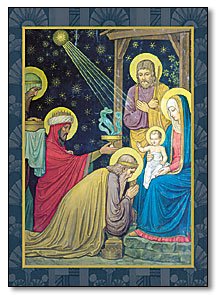
 January 6 is the Feast of the Epiphany of Our Lord. The word Epiphany means revelation and this is the season when we consider the ways God reveals himself to us in Jesus Christ.
The Gospel reading for January 6 (at least in our tradition) is Matthew 2, the story of the wise men or magi from the east who visit our Lord in Bethlehem.
First a couple of factoids. While it is generally traditional to show three wise men, the Scriptures don't, in fact, tell us their number. Only that their were three gifts. It does use the plural so it was more than one, but it could've be 2 or 20 for all we can say.
Another tidbit is that we don't know their names or exactly where they came from. Generally we'd say that they were Persian or Babylonian. That's a sound guess. We know from Old Testament history that the Jews were taken into captivity into Babylon for 70 years and many remained when Cyrus the Persian overtook Babylon. Thus Persian-types and Babylonian-types were somewhat familiar with Israel and the Hebrew prophecies. These ancient cultures were also renowned for their astronomical observations.
What was the star exactly? The Bible says that it moved to guide the magi to the very house where Jesus and his mother were staying. Many have undertaken to ascertain what kind of star this might be. Stars are fixed and do not move. What about the records of other star-gazing nations? Surely any kind of major change in the heavens - such as the appearance of a new star - would have been universally noticed.
I think it's key to note that the Greek word used here is aster. We get the english words astronomy and asteroid from it. Aster can refer to just about any heavenly body so it need not have been a star as we scientific moderns would define it. Maybe it was a meteor, a comet, or an uncommon alignments of the planets. Dozens of theories have been offered.
I find the most compelling explanation to also be one of the oldest. St. John Chrysostom, in the fourth century, proposed that the aster in Matthew 2 was an angelic being of some kind. That makes the most sense to me. Why? Because it is hard to find a widely convincing explanation if we only consider the known phenomena of nature. Comets or nova would have been observed and written about. One tantalizing theory involving the alignment of certain planets and constellations is fascinating but it would fail to explain how it guided the magi to the specific house where Jesus was staying.
And besides, angels are involved in almost every other aspect of the birth narratives. It makes sense that they'd be involved here as well. And it relieves us of having to explain it by scrunching together scientific data into a handful of not-wholly-satisfactory speculations. It fits the nature of an angel to lead people to Jesus. And there is ancient church support. To me, it's the most compelling explanation.
For more reflection on the Epiphany, head over to Aardvark Alley.
Friday, January 06, 2006
Blessed Epiphany to You!!

Best Blonde Joke Ever
Thursday, January 05, 2006
Child Rapist Gets 60 Days
Here's a story to give you morning indigestion.
First, there is a man named Mark Hulett who raped a little girl repeatedly over a span of four years starting when she was seven years old.
Second, the prosecutor asked for 8-20 years in prison, which seems like a light sentence to me. I would support hanging the man by his neck until dead. And I suspect a large majority of the American population would agree with me.
Except, of course, the judge overseeing this case. It seems the man was convicted of the crime and the judge only gave him 60 days. And his reasoning: "The one message I want to get through is that anger doesn't solve anything. It just corrodes your soul."
That's got to be the stupidest thing I have ever heard. Who is this message for? The criminal or the victims? And of course he is dead wrong. Anger solves lots of problems. Who does this judge think is worse, the child rapist or the people who get mad at the child rapist? You want to know what is corrosive? Child rape. That's pretty bad.
For someone who is trying to eradicate anger, this fellow - Edward Cashman - is flopping big time. For instance, he's made me angry. What about you? What about the parents of the 11 year old victim? I'm guessing they were mad at Mark Hulett for repeatedly raping their daughter. Now, instead of helping de-corrode their souls, Judge Cashman has only made them angry at one more person . . . him.
And this is what really snaps the camel's back. The judge said he doesn't want to punish Mark Hulett because punishment - and here I have to quote - "doesn't work." What? Doesn't work how? The purpose of punishment is to punish. In what way does punishment not do that? Oh, I suppose if you think that punishment is supposed to cure cancer, then it doesn't work. Or if punishment is supposed to make the criminal a better person, then it doesn't work at that either. But the purpose of punishment, as far as I see it according to St. Paul in Romans chapter 13 is to . . . you guessed it, punish.
I thank God that there will be a reckoning. And I know full well that apart from God's grace in Jesus Christ, I likewise deserve God's wrath. No less than Mark Hulett. And that is why Christ instituted the Church: to preach about the atonement and the forgiveness of sins. And the reason why God instituted the government is to punish wrongdoers like Hulett.
Judges and courts exist, not to implement their own wills upon others - nor to forgive sinners and absolve the penitents for that matter - but to implement the just and perfect will of the Creator and Divine Lawgiver and Judge of All in these circumstances. Morally bankrupt judges like the Honorable Edward Cashman should recall that God is angry with sinners and it's his job to punish them.
Any dissenters should please take this up with St. Paul in Romans 13 and not me.
(Hat Tip: Michelle Malkin)
Wednesday, January 04, 2006
"The Island" - A Review
I don't want to give away plot spoilers if you haven't seen it and intend to. It is enough to say that it deals with the question of whether it is ethical to farm and use human beings to save the lives of other human beings.

Fellow Lutheran blogger, Blood and Water, has a very nice succinct review. Sphere: Related Content
Tuesday, January 03, 2006
Great Time Wasting Link
For a way to kill time and accomplish nothing, go here.
Sphere: Related ContentSunday, January 01, 2006
What's In a Name?
A couple of years ago, Dr. Gene Edward Veith wrote a piece for WORLD Magazine on contemporary trends in naming children. And he offers some interesting insights.
Back in the olden days, people used to give their children names that meant something. Some cultures give names to their children that express some feature or characteristic they hope to see in their child. The American Puritans, for instance, started the practice of naming their children after biblical virtues such as Faith or Hope or Charity. The hippie generation chose dreamy nature names such as River or Autumn. Many Christians through the ages have chosen names either from the Bible or from significant figures in the history of the Church. So saint names such as Joseph or Elizabeth became quite popular. I’m waiting for the day when Christians decide to get really cutting edge and choose names from the ancient church fathers. But I doubt if we’ll be seeing any little Tertullians or Cyprians or Polycarps pitter pattering around here any time soon.
One of the contemporary trends – and this is not a criticism at all, just an observation – is for parents to invent brand new words for the names of their children, not chosen because of what they mean, but for how they sound. So there are all sorts of unique combinations of letters and spellings.
And, to me, the most interesting trend nowadays is when people name their children using the brand names of their favorite consumer products. So according to one researcher, in the year 2000 there were 298 girls named Armani, after the line of designer clothing. Seven boys were named Del Monte, apparently after the canned vegetables. And 21 girls were named L’Oreal, after the hair dye.
The most surprising examples were the two boys, one in Texas and one in Michigan, who were named ESPN after the cable sports network. Their names are really spelled E-S-P-N. I’m told this is pronounced “espen.” Whatever. It’s a free country.
I’m not making any judgments upon how parents choose to name their children, particularly since in our society, if you don’t like your name, once you get to a certain age, you can get it legally changed.
However, it does seem that from God’s perspective, His name is more than just what He wants to be called. When the Lord spoke to Moses through the burning bush to enlist him to lead the Israelites out of Egypt, Moses was hesitant. He had reservations about whether he could pull it off, so he asked God, "If I come to the people of Israel and say to them, 'The God of your fathers has sent me to you,' and they ask me, 'What is his name?' what shall I say to them?" God said to Moses, "I AM WHO I AM." And he said, "Say this to the people of Israel, 'I AM has sent me to you (Exodus 3).'" The Hebrew word for this is YHWH.
And God’s name is special. He wants us to use His name, that is, He wants us to call upon His name in every time of need and He wants us to use His name in prayer, praise and giving thanks. He does not want us to use His name in vain or to turn His holy name into a curse word.
I saw a character in a movie one time who thought that God’s name was Howard. Why did he think it was Howard? Because don’t we say, “Our Father who art in heaven, Howard be thy name?” No, of course not. We say “hallowed” be thy name. To hallow something is not to hollow it. To hallow means to keep it holy. To preserve the sanctity of something. And we keep God’s name holy not just by cleaning up our vocabulary, but also by how we live our lives.
People used to teach their children to behave properly because if they did not, it would bring shame upon the family name. Well, that is pretty much how God feels about it too. You are called Christians, named after Christ. You have been baptized into the name of the Father, the Son and the Holy Spirit. His name is on you. And people are watching you to see how you live. And if you profess to be a Christian, but live like the devil, you bring shame and dishonor to the name of God. You make God look bad.
Another way a person can bring dishonor to God’s name is to teach false doctrine. Any time you attribute something to God which He did not, in fact say, and does not mean, you are putting lies into his mouth. And this is why St. Paul tells young Timothy: “Watch your life and doctrine closely. Persevere in them, because if you do, you will save both yourself and your hearers (1Tim. 4:16).”
And “He was named Jesus, the name the angel had given him before he had been conceived (Luke 2:21).” Jesus is the Greek form of the Hebrew name Y’shua or Joshua. It means “God saves.” That’s what the angel told Joseph before Jesus was born: “You are to give him the name Jesus, because he will save his people from their sins (Mt. 1:21).” It is not just what that baby was to be called. It is what that baby would do.
Here is the Veith article.
Saturday, December 31, 2005
A Match (Mer)maid in Heaven?
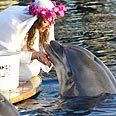 Check this out. This is whimsical, but is not a joke.
OK, so the nuptials this past week between a wealthy British woman and a dolphin don't exactly qualify as a legal marriage. But I defy any defender of gay marriage to explain why it shouldn't be.
Who gets to define marriage? I say we let natural law and common law along with thousands of years of Judeo-Christian tradition decide. According to these sources, generally speaking, there will be agreement that marriage is defined as the union of one man and one woman. While the Old Testament does portray instances of polygamy, it seems to be mostly a non-issue by the time of Christ. Unquestionably, the teachings of Jesus and St. Paul forge the basis for the traditional view. And certainly, even Genesis (Adam and Eve) is supportive.
But according to some, marriage should be able to be defined by the whims and preferences of a particular society. In that case, how can polygamy or polyandry not be legalized? Or marriage between children? Or between close relatives, such as mother and son or sister and brother, etc.? Why not group marriage? Why not marriage with oneself? Or with an inanimate object? Or with a deity? Or between a 41-year-old British millionairess and a dolphin.
HT: Watersblogged
Friday, December 30, 2005
Pope and Stiegemeyer Agree
Benedict XVI stated the other day that embryos are "full and complete humans." See here.
Now here is the interesting part. He made this statement on Wednesday, December 28. However, I blogged the same kind of thing, only more eloquently, on Tuesday, December 27. I submit this as proof positive that the Pope reads The Burr in the Burgh. . . and plagiarizes from it.
Naw, just kidding. I'm glad to see his statement.
Thursday, December 29, 2005
Why European Women are Converting to Islam
First, it reminds me that all human beings innately understand that there must be moral standards by which to live. It stems from the natural law imprinted by God upon every human heart. Contemporary Western culture has largely eviscerated the notion of moral absolutes. And this will result in oceans of suffering. As a pastor, I am constantly made privy to the chaos, frustration, cruelty, and hopelessness of people's lives. Law and order are attractive. I find that many times, damaged people prefer tyranny over anarchy. They'd rather have a moral slave-driver than utter confusion. So I believe this is one of the attractions of Islam. Not only is it entirely law based, it creates such a system of laws that submission to God is seen as obtainable outward observance. This is not unlike the Pharisaical religion Jesus confronted. A legal system that defines what you eat, what you wear, how many steps you can take on the sabbath, etc. As burdensome as this is, it is better than having no direction whatsoever. It also seems easier than the conversion of the heart that Jesus demands.
So in the first place, the Christian Church must not shy away from its responsibility of instructing people in morals. This includes behavior and attitudes. There is a place for moralism. But it has to be done properly. What I see in the modern church is on the one side, a form of antinomianism, a belief that we shouldn't tell people that they are wrong or sinning because it might hurt their feelings. Instead we should talk only of God's love. Or His grace and forgiveness in Jesus Christ, if you will.
But there is also the trend to re-define moral teaching so that it better suits us. Thus churches invent new virtues: tolerance above all others. Love is redefined as affirmation. We think we are loving when we make people feel supported in whatever it is they choose to do or be. That is, in fact, not love. Love means telling a person that the house they are living in is on fire so that they know to escape, even if it means disrupting an otherwise peaceful dinner.
In a way, Islam might be scratching an itch. And if the Christian Church were doing a better job instructing and guiding people on how to live good lives, then perhaps they would be less likely to subjugate themselves to tyranny.
And finally, we must continue tirelessly to emphasize the God-Man Jesus Christ. We must hold him before the world, not merely as a moral examplar, but as the final sacrifice for our sins. For no matter how we re-invent morality to make it more attainable, our hearts - and the Holy Spirit - will continue to condemn us. And that is because we all do, in fact, fall far short of the standard of perfection set by God. And it is only when we teach morality properly, when we communicate to people that God requires us to be perfect, that we can actually make sense out of the cross. People are despairing. And some are turning to counterfeit religions, built upon submission, for solace. The Church offers authentic hope, not in a moral system, but in the forgiveness of sins.
Tuesday, December 27, 2005
Abortion and Christmas
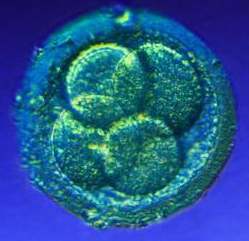 On this, the third day of Christmas, I have been thinking about the incarnation of God's unique eternal Son. His enfleshment. St. John wrote: The Word became flesh and made His dwelling among us.
One of the greatest turning points in history was the moment when God became a man. But really that is not the Christmas event.
Christmas is about the Nativity of Jesus. "Nativity" comes from the Latin natus or "birth." If one is a native of a place, it means he was born there. The Son of God become a native of planet earth. And Christmas is the celebration of that fact.
But I am talking about his incarnation, his enfleshment. God did not become a man in Bethlehem in the cattle stall overlooked by shepherds and angels. No, that happened approximately nine months earlier, presumably when the angel named Gabriel announced to Mary that she would conceive and give birth to a child.
It seems to me that we put so much emphasis on the birth of Jesus, but too little upon his conception. You might say that the birth implies the conception. But this is a very important point I am trying to convey. God became a zygote.
Some modern churches have altered the words of the Nicene Creed to become more politically correct, and in so doing have sold their souls for a mess of pottage. The traditional English translation states that the Son of God "became man." In order to avoid the appearance of male chauvinism, some have rendered this instead as "became fully human." That is a very unsatisfactory translation. I understand the purpose. By "man," we do not mean to imply that the incarnation does not benefit people without penises. So we say Jesus became a human being. And that is true enough. The trouble is with the phrase "fully human." Fully Human? What other options were there? Could the Son of God have entered the world as a partial human? A potential human? Maybe a cyborg or a chimera? The phrase "fully human" implies that there are degrees of being human and that is impossible for a Christian to believe. In the words of Frederica Mathewes-Green:
You see, there are ethical implications for what we believe as Christians. It is not possible to take seriously the incarnation of the Son of God while tolerating abortion. Read that sentence again. Read it twice because anyone who denies the true humanity of Jesus is in serious danger.
I believe that God loves each and every created person. I believe that we begin when our bodies begin; that each person lives the curve of a continuum, that the eighty-year-old grandmother sitting in a front porch rocker, holding her grandbaby in her lap, is the same person she was when she was sixty, when she was forty, when she was twenty, when she was eight, when she was three. She's the same person over all that span, the same Mildred, whether that whole person is contained in a body the size of an adult, or adolescent, or child or baby. She was the same person when she was one year old, and on the day she was born, two months before she was born, five months before she was born, and in the very moment she was conceived, when her parents' sperm and egg fused. That single cell was a complete human body; in that cell was contained all the genetic information she'd need for a lifetime. That cell was human, it was alive, and it was unique; its DNA was different from her mother's and her father's, a brand new human never before seen on earth. All that was there in that single cell, and its life is a continuum from that moment until the moment of her natural death.
I believe that where there is a living body, there is a soul. There is no such thing as a living body without a soul; I've never encountered such a concept outside zombie movies. You can't, therefore, say that this living, unique human body suddenly becomes a person at six months gestation, or at birth, or some other time. Where there is a living human body, there is human life.
St. John wrote that anyone who denies the incarnation of the Son of God is the antichrist. "Many deceivers, who do not acknowledge Jesus Christ as coming in the flesh, have gone out into the world. Any such person is the deceiver and the antichrist (2John:7)."
A person who accepts abortion must reason that the object being removed from the woman is non-human or somehow less than human, otherwise it is clearly murder. A Christian, however, believes that God became flesh at the point of conception and this confirms for us the tenet that a zygote is a human being.
I don't see how anyone can, in good conscience, celebrate Christmas without opposing abortion.
See also Dr. Nigel Cameron's article Bethlehem's Bioethics. Sphere: Related Content
Monday, December 26, 2005
My Wife's Thoughts on Anne Rice's Book

Some you read what I wrote after finishing Anne Rice's newest novel called Christ the Lord: Out of Egypt. Here is what my dear wife thought. I concur 100%
Stephen Got Stoned
 Everybody Must Get Stoned. That's the chorus of a good ol' Bob Dylan song. You probably heard that song and thought it was about marijuana. Not quite.
Well, they'll stone ya when you're trying to be so good,On December 26th, we commemorate the martyrdom of St. Stephen, deacon. Stephen spoke the truth and was killed by stoning, which next to crucifixion, has to be one of the more unpleasant ways to die. The first persecutors of the Church were not the Romans, but the Jews. Stephen was killed by Jews with Saul of Tarsus (later to become St. Paul) overseeing the whole thing.
They'll stone ya just a-like they said they would.
They'll stone ya when you're tryin' to go home.
Then they'll stone ya when you're there all alone.
But I would not feel so all alone,
Everybody must get stoned.
If you need something to keep your Christmas observances from becoming too flighty, recall the witness and death of St. Stephen. A reminder that with the Messiah comes much suffering and bloodshed. And as Bob Dylan and Jesus both tell us, "Everybody must get stoned." Of course, that's not an exact quote on the part of Jesus. He actually said, "Anyone who wants to be my disciple must take up his cross and follow me." Same diff.
Being a Christian is not about whether we can convince Macy's employees to say "Merry Christmas." It's about self-denial. It's about killing your old sinful nature by daily repentance. It's about rising to new life with Christ. Martyrdom is an ESSENTIAL part of life for every Christian.
Sunday, December 25, 2005
Are Most Clergy Introverts??
This does raise some interesting questions. To what extent is the personality of a pastor important to the success of his ministry? Boy, that could open quite a can of wormies.
Not just every person who wants to be a pastor should be one. And certainly, most definitely, not every person who says, "I feel that I am called to be a pastor," should become one. There are biblical qualifications to become a pastor. And this has absolutely nothing to do with what you or I feel about anything. In the Bible, God called plenty of men who wanted it like a hole in the head.
And as I read the epistles of St. Paul to Saints Timothy and Titus, I don't recall seeing extroversion listed as one of those qualifications. Not explicitly, that is. But it is necessary that he be a man respected in the community, with a stable family life and obedient children, and it says he must be apt to teach. St. Paul also says that a pastor must be hospitable and he commands Timothy to do the work of an evangelist. None of that is exactly the same thing as extroversion, but it certainly means that an extreme introvert, no matter how brilliant, pious or well-meaning might not fit the biblical qualifications. Unless, that is, he is able to overcome his natural tendencies toward introversion enough to fulfill his duties.
I don't know what the experts would consider me. An extrovert or an introvert. Can a person be both? Generally, I think I'm an introvert. The perfect vacation for me is a quiet hotel with a pool or a beach, no phones, a stack of books, near an excellent brew pub and espresso bar. With my family. I enjoy solitude. In social settings, I tend to sit off to the side EXCEPT when I am the host or when I am with people I am very comfortable with. Then I can be quite extroverted.
But so what? How much of this is important to me being a pastor? While I think doing psychological and personality analyses of seminarians does have some merit, I am repulsed by how much attention is paid to such things. Some of the best pastors I know today, had lousy results when they took the tests. And some of the real go-getter types turned out to be jerks or perverts.
Generally, I believe way too much attention is paid in the church's ministry to the behavioral sciences and too little to pastoral theology.
HT: Mere Comments
Friday, December 23, 2005
Atheist Defends Christmas
In any case, here is a clear-thinking atheist Englishman who recognizes the cultural debt owed by Western civilization to Christianity. He writes: "I rejoice wholeheartedly as an atheist that I live in a Christian culture...."
Prayers for Professor Marquart
I was a student of his during my years at Concordia Theological Seminary (1991-1995) in Fort Wayne, IN. His area of expertise is systematic theology or dogmatics. While I loved many of my professors and admired a number of them. Dr. Marquart is certainly one of my most loved and admired.
Professor Marquart is particularly gifted at being clear. And in the field of theology, you may not realize how important that is. He is able to take complicated subjects and explain them and their ramifications with clarity without oversimplification. He is also particularly skilled at being simultaneously witty and winsome as well as bold.
A number of Lutheran bloggers are commenting on Dr. Marquart, not to eulogize him as if his life were over, but to speak well of a man who has accomplised much, is accomplishing much, will continue to accomplish much and, I suspect, will always accomplish much for the Church.
His pastor, Rev. David Petersen, has these touching comments.
Thursday, December 22, 2005
Hollywood - Like mainline Protestant Churches - Is Obsessed with Gay-ness
The two leading armies in this crusade are most mainline protestant churches and Hollywood. Take the Evangelical Lutheran Church in America, for instance (I am part of the smaller, more conservative Lutheran Church-Missouri Synod). They are unendingly forming commissions and task forces to study, re-study, examine and re-examine human sexuality. One faithful ELCA pastor I know says that the point is to keep "studying" the issue until they get the votes they want.
Now here's an article pointing out that virtually all of this year's likely Oscar contenders are gay movies.
Junk Movies and Lost Profits
'Brokeback Mountain' leads Golden Globe nominations
Plummeting 2005 box office sparks Hollywood crisis
Wednesday, December 21, 2005
Willow Creek: Closing Church to Support Missions
I know I've blogged already about the mega-churches around the country who are cancelling church for Christmas this year, even though it falls on a Sunday morning. But this article was just too rich to pass by.
First is this gem:
At first glance it does sound contrarian," said Rev. Gene Appel, senior pastor of Willow Creek. "We don't see it as not having church on Christmas. We see it as decentralizing the church on Christmas--hundreds of thousands of experiences going on around Christmas trees.So they don't see it as not having church on Christmas, even though they're not having church on Christmas. What kind of remark is that? [George Orwell, Where are you?!] "I'm sorry officer, I didn't see it as going over the speed limit. I saw it as decentralizing the speed limit." Right.
And then there is this from the same article:
The resources that would have funded the church's Sunday service this year will go toward the DVD instead, potentially touching thousands more people than the same message from the stage on Sunday morning, Parkinson said.This one takes the cake. . . and the pie, the strudel and the baklava. They are producing an evangelistic DVD with the money they'll save from cancelling their worship service. I wonder if they've noticed that there are 53 Sundays in 2006. Think of all the money they could spend on missions if they cancelled every service. I'm for that. Sphere: Related Content
Get Ready to Debunk Da Vinci

This is a handy little guide to help you sort out the Da Vinci Code garbage once the upcoming movie hits. It'll be a cultural tsunami and Christians need to know how to respond intelligently. There are many helpful resources, but I like this one because it's short. I've bought copies to give away.


