With the recent film, The Exorcism of Emily Rose, the topics of exorcism and demonic possession have been getting renewed attention. It seems clear to me that there are some not-so-good risks about stirring up too much interest in Satan and his demons. We don't want to do or say anything which might cause impressionable people to develop an unhealthy fascination with the occult. However, I think that it is equally dangerous to speak of the devil too little. The New Testament does not allow us that option. St. Peter wrote: "Be self-controlled and alert. Your enemy the devil prowls around like a roaring lion looking for someone to devour. Resist him, standing firm in the faith. . . (1 Peter 5:8-9a)."
The Christian can be confident that Satan is a defeated enemy. But he and his minions can still cause great harm and mischief in our lives. Demons certainly are behind many of the messes in the lives of the people we seek to minister to. So be sober and watchful.
I just discovered an interesting new blog called One True God Blog. Its contributors are theologians and writers who represent Evangelicalism, Roman Catholicism and Eastern Orthodoxy. Here is their discussion on demons.
Monday, September 26, 2005
Demonology Discussion

Saturday, September 24, 2005
Pro-Abortion Media: Saying the Opposite of What You Mean
If you read a headline that said, Irish Favour Legalising Abortion, what would you assume would be the substance of the article? Doesn't this headline lead you to think that, gee, I dunno, the Irish people are in favor of legalizing abortion? Is that a fair assumption, do ya think?
Well, what if you then actually read the article and the first sentence said: Irish voters under 35 strongly favour legalising abortion, but if a referendum on permitting abortion was held now it would be defeated, according to an opinion poll.
The rest of the article goes on to give statistics showing that though the young and hip crowd would like a referendum on the current law, in fact, the majority of the Irish people are against it. Don't you think the more sensible title of the article should be: Irish Don't Favour Legalising Abortion?
What's up with that?
My thanks to Jivinjehashaphat for this.
Friday, September 23, 2005
Book Tag
I love these things. I have been tagged by Cubicle Reverend to participate in a meme.
1. Total number of books you own?
Unknown. We have books and bookshelves in every room of the house. There are piles and stacks of books all over my home study. And my church study has bookshelves along 3 of 4 walls.
2. What is the last book(s) you bought?
I utilize our local public library and inter-library loan system a lot. I'm actually trying to cut down my book purchases a little, because there's only so much space out there. But the last books I bought were:
- "God and the World" by Joseph Cardinal Ratzinger (now Pope Benedict XVI)
- A commentary on Colossians by Paul E. Deterding
3. What was the last book you read?
- "The Beardless Warriors" by Richard Matheson (a compelling WWII novel)
- "The Cases that Haunt Us" by John Douglas
- "Prozac Nation" by Elizabeth Wurtzel (about to finish)
4. List 5 books that are particularly meaningful to you (in no particular order):
a) The Book of Concord (the Lutheran confessions of 1580)
b) The Chronicles of Narnia (actually 7 slim volumes) by C.S. Lewis
c) The Lord of the Rings (3 volumes) by J.R.R. Tolkien
d) The Fire and the Staff by Klemet Preus (a very enjoyable summary of Lutheran doctrine and practice)
e) Citizen Soldier by Stephen Ambrose (I wanted to mention something non-fiction that was not a book of theology. And this is a fascinating study of the American G.I. of WWII.)
5. Tag five people, any five people who read:
Incarnatus Est
Jottings and Such
Beggars All
The Southern Conservative
Tales from the Dorkside
Expert Tells Congress Global Warming Not to Blame
What's going on? Last year it was Florida. This year, it's Katrina and now Rita. You, like I, have probably heard the speculation that the recent spate of intense hurricanes that have hit our U.S. gulf coast in the last few years are partly the result of global warming.
One of our nation's chief hurricane experts disagrees. Go here and here to read what Max Mayfield, the Director of The National Hurricane Center has to say. He testified to congress saying that it is simply part of a natural cycle. If it were global warming, then we should be seeing the same effects worldwide. But that is not the case. In fact, he states, in some areas, hurricane activity has significantly decreased.
Thursday, September 22, 2005
"Gotta Serve Somebody"
Bob Dylan sang, "You gotta serve somebody. It might be the devil. Or it might be the Lord. But you gotta serve somebody."
Well, here is a good question for us: Is a pastor the servant of the congregation? Or is he a servant of Christ Jesus? The answer is "yes."
A Christian pastor is not a lord or master over his congregation. So he is not to tyrannize them. This happens whenever a pastor tries to micromanage every sphere of congregational life and sometimes when he allows his lay leaders no opportunity to make decisions of any consequence. In other words, I don't have to impose my ideas about our new parking lot construction as if I'm the boss. I have plenty of people here who know more about that than I do.
A pastor also becomes a tyrant when he asserts his own personal opinions as the Word of God. For instance, I may have very strong political views. Would it surprise you if I do? But outside of teaching people what the Bible says about certain moral issues and the role of government, I don't have any business - as their pastor - of commanding people to vote for this candidate or another. I suppose I could envision scenarios were this would be otherwise, but not often in our democracy would this be the case.
Or a pastor can become a tryant when he tries to govern his members in ways that do not belong to the pastoral ministry. I can (must) tell someone if they are living in a sinful manner. But I can't tell them whom to marry, which house to buy, where to send their children to school, etc. I can (must) exercise church discipline with unrepentant sinners, but I have no civil authority over them.
There have been ministers who have abused their holy office in the ways mentioned above. But at the other end of the spectrum, you have congregations who want to tyrannize their pastors. That is no less ungodly. There was a fine book published a few years back called Clergy Killers. And it's about a growing tendency of congregations to adopt a "hire-and-fire" mentality. "We hired you. You work for us. Do what we say, or we'll can you."
But the fact of the matter is, I don't work for my congregation. I am not their employee. I am a servant called by God, through the congregation. But I answer to God first, my church council or board of elders second. And where those two entities may conflict, God gets my first allegiance. Now, I personally, have been blessed not to have a tyrannical congregation, not in the least. Quite the opposite. They are loving, generous, kind and willing to be taught from Holy Scripture. They have also exercised an extraordinary measure of patience for their young, relatively inexperienced pastor. And I can only pray that I will never be a harsh overlord toward them.
Sometimes pastors can be over-bearing, but an over-bearing church board can be just as pernicious to the kingdom of God. God tells us to submit one to another. It's like marriage. Without submission, mutually, there can be no love-making.
Yes, the pastor serves the congregation, but he does so as an agent of Jesus Christ. He serves Christ in the sense that he is waiting on the Body of Christ. Jesus told Peter, "feed my lambs." We are the undershepherds who answer to the chief Shepherd and bishop of our souls.
Pastor David Petersen, over at Cyberstones, has a further reflection on these sentiments.
Wednesday, September 21, 2005
Is It a Sin To Be Stupid?
In the Lutheran denomination I belong to, it is recognized that the only legitimate reasons to expell a pastor from his call are: persistence in false doctrine, openly immoral life, and physical or mental incapacitation. It's a good thing that "doing something stupid" is not one of those criteria. Every pastor, myself included, makes foolish mistakes. But sometimes you hear about something that just makes you ask "What in the world was he thinking?!?!"
CBS News reports that a 78 year old Roman Catholic priest in Austin, Texas asked a group of children to come forward during mass - I'm guessing for some kind of children's sermon or something - and he proceeded to prick each one of them with a pin.
When I read this article, I was dumbfounded. Apparently, he'd taken a single unsterilzed needle and poked, breaking skin mind you, a flock of children. The article also states that he nailed a few adults in this stupid exercise as well. He claims that this was to illustrate that suffering is part of life and that Jesus suffered for us.
So what's the big stinkin' deal, you ask? Let me count the ways:
1) It's a health risk. Especially if it's true that he poked adults as well as children. Do you trust your fellow parishoners enough to share needles with them? Anyone hear of HIV or hepatitis? I realize the risk is probably relatively small, but it was a stupid thing to do. Listen, I'd drink the blood of Christ out of a chalice in a cathedral full of AIDS patients, but I would not let someone prick my son and two dozen of our closest friends with a single needle.
2) The report says that the priest wanted to teach them about the pain that Jesus suffered on the cross and, in his words, "that suffering is a part of life." Oh come on. There are much better ways to teach children about the pain Jesus endured. How about a good scourging? And it is ridiculous, in my mind, to think that we need to give pin pricks to children to teach them a lesson most of them ALREADY know all too well. That life hurts.
Tuesday, September 20, 2005
I've Seen "The Exorcism of Emily Rose" and Here Is What I Think
"The reason the Son of God appeared was to destroy the work of the devil." - 1 John 3:8
Many of you have perhaps seen the new movie called The Exorcism of Emily Rose. It appears to be doing well at the box office as a fall release. It has attracted the attention of the media, in part, because the director is a professing Christian and the movie is based upon a true account.
This week's WORLD magazine has an interview with Scott Derrickson, the director. Today, I went to see it and in my evaluation, it is a very good movie.
As the title suggests, a girl named Emily Rose is possessed by evil spirits. This occurs while she is away for her freshman year of college. The priest who eventually performs her exorcism is on trial for negligent homicide (or something like that). I don't want to give away too much of the plot, but that is the initial setup.
The movie is a mixture of the genres of horror and courtroom drama. The trial is taking place in the present with the scenes of Emily's possession and exorcism shown as flashbacks. It has some genuinely scary moments and disturbing images. But if you go expecting to see a typical gross-out bloodfest or tons of computer generated special effects, you will be disappointed.
The cast was excellent. Laura Linney plays the agnostic defense attorney for Father Moore, played by Tom Wilkenson. Campbell Scott is the devoutly Methodist prosecutor. And Jennifer Carpenter excelled in the title role. In particular, I must single out Wilkenson and Carpenter.
It was so heartening to see a Roman Catholic priest portrayed in a major Hollywood film so sympathetically and believably. And there is nothing less secularized or rationalistic than showing a priest performing an exorcism. Wilkenson's Father Moore is intelligent, compassionate, and devout. He is also articulate and courageous.
And Jennifer Carpenter. . . what can I say? I almost wondered if she really was possessed. It was creepy, but she and the director exercised just the right amount of restraint with her character. I really felt sorry for the girl she played and then came to admire her.
I'm a fan of Billy Friedkin's 1973 film adaptation of William Peter Blatty's book The Exorcist. But I am tempted to say that this was a better movie. I really liked the less sensationalist approach. Y'know the spinning head and pea soup projectile vomiting was a bit much. Plus, honestly, this movie is just less disgusting all round. Less blaspemous language, less sexual perversity, etc. Now that may be a mark against it in terms of realism. But I think if you are trying to make a film to convince the average Joe that there is more to life than Horatio's philosophy (as Shakespeare's Dane would say), going too far with the spectacle can be distracting.
One criticism I would level at the director is that I hate it when horror movies just try to startle you with a sudden loud noise or someone jumping out from behind a door. And it's not because I don't like to be startled - because actually I kinda do - but because it's low brow. If you can't frighten me with the story, the plot or the characterizations, then forget about it. Don't jump at me and yell, "Boo!"
There are some theological deviations here and there. I wouldn't say it is a Christ-centered story. The article of justification is never articulated. Alone, it will not convert anyone.
But here is why I believe this film, and others like it, are important. It treats Christian doctrine and the Christian church with respect. And it promotes the idea that there are spiritual realities in the universe we inhabit. In an increasingly secularist age, it is helpful to instill the belief that some things cannot be explained by science or dissected under a microscope. And though it doesn't give the explanation of how, it is clearly shown that the Christian Church holds the key to salvation.
But I will go further and say that I appreciated the movie because it is about Satan. And it's not a farce or an exploitive caricature of Satan. No, this is the real deal. The two errors people can fall into with regard to the devil is to think about him too much or to think about him too little. For those who think about him too little, consider that Jesus spoke about Satan and hell quite a bit. Most of what we know about hell comes from the mouth of Jesus Christ.
If I were an average Joe, someone who generally considered himself a Christian but didn't attend church or pay much attention to religion, I think this movie would get under my skin. And that appears to have been the express intention of the director. Movies like this would make me afraid to go to hell. And that would be useful progress for many people, even some people who sit numbly in our pews week after week.
Monday, September 19, 2005
How to Pick a Church
With the American love affair with the automobile, it is no longer seen as necessary to attend a church near one's home. I know people who drive past half a dozen churches to get to the one they choose. Well, how is this choice made?
Unfortunately, I fear, many people make a church choice based on not-so-good reasons. I am not one of those who says that all churches are basically the same or that our denominational differences do not matter any more. I think the differences do matter because truth matters. Denominational differences arose from doctrinal disputes. And while Christian history has not been free of petty arguments, legitimate doctrinal differences should not be simply glossed over.
You see, I am of the conviction that the Bible is the Word of God. Inspired and Inerrant. So differences of interpretation are not merely personal preference, opinion or whim. They are disagreements about what God has said. And since presumably all Christians care to know what God has truly said in His Word, we want to clarify and be certain that we know what we believe. For instance, when Jesus said, "This is my Body...", he either meant "This bread truly is my body," or He meant "The bread merely represents (thus 'is not') my body." Which is it? Jesus said it. I think His intention was to be understood.
My point is that doctrine should be the chief criterion by which a person or a family determines which church to join. Not the personality of the pastor. Not the beautiful architecture. Not the accomplished musicians. Not the size, the wealth or the racial makeup of the congregation.
Of course, I speak as the pastor of a small congregation. I have seen people choose a church that teaches (or tolerates) false doctrine merely because they have a bigger Sunday school or a more dynamic youth group. Hey, I'm all in favor of big and dynamic. And when the doctrine is straight, those are fine reasons to select a congregation.
What trouble me - and what I hope troubles you - is the rampant indifference to teaching.
Friday, September 16, 2005
Cosmetics sold in UK Made From Human Remains
A story in The Guardian earlier this week reports that cosmetic products made in China from the skin of executed prisoners is being marketed in the United Kingdom. Sounds like the nice lampshades and wallets made out of Jews in the 1940s. Only with one difference, in this case no one seems to mind that much.
There is no outrage in The Guardian's reporting. Only the briefest suggestion that this might be immoral or wrong in some way. It's not technically illegal. A "grey area" they say. I thought Europeans were generally so anti-capital punishment. But, I guess, since they're from China, the likelihood that these prisoners were Christians or champions of democracy is great. Killing such folk doesn't seem to irritate Europeans as much as it used to.
In the article, much was made of the fact that using human remains to make cosmetics is culturally acceptable to the Chinese. It's hard to miss the implication that we shouldn't be too quick to impose our benighted Western values on another culture.
But I'd bet you a coke that if these cosmetics are tested on lab animals first, there'll be picketing in the streets of London.
Thursday, September 15, 2005
The Exorcism of Emily Rose
The Exorcism of Emily Rose is a new film based on a true account of a woman who is deemed to be demon possessed by the Catholic church. Something goes wrong in the course of her exorcisms and she dies. The priest who was performing the rites then faces trial. I haven't seen it yet, so I cannot comment much directly on it. But the reviews have been intriguing, though quite mixed.
Blogger Darrell at Southern Conservative loved it and recommends that all Christians go see it. Go here to Christianity Today for an overview of reviewer opinions.
Have you seen it and what did you think?
Wednesday, September 14, 2005
Banning Marriage (Gay and Otherwise)
A new political party in Sweden called The Feminist Initiative is running on a platform calling for the abolition of marriage. All marriage. The idea, allegedly, is that marriage "is not about love, but about ownership." Instead they propose some sort of domestic partner arrangement that would not take gender into consideration at all, nor would it be restricted to only two partners. I'm frankly shocked at their intolerant approach. They do not permit sheep and goats to become legal partners with humans! That's species-ism! Somehow this is seen as a good move for women. Well, how does this party try to appeal to male voters? A six hour work-day. I'm sure all the Mr. Mom's are miffed at the assumption that all the men out there are the bread-winners. That's sooo retro.
What's next people?!
Here's the link, since I wouldn't blame you for thinking I made this up. Someone please tell me this is a spoof. I don't think it is.
Tuesday, September 13, 2005
Great Books on Depression
Not the "Great Depression," as in the stock market crash of 1929. But well written memoir type books by people who've suffered from severe depression. Right now, I'm enjoying Prozac Nation by Elizabeth Wurtzel. She's really a very good writer. Other good ones include Girl, Interrupted by Susanna Kayson and The Bell Jar by Sylvia Plath. None of these come from a Christian perspective but they are very enlightening and insightful reads nonetheless.
Here is an intriguing quote from Prozac Nation:Homesickness is just a state of mind for me. I'm always missing someone or someplace or something; I'm always trying to get back to some imaginary somewhere. My life has been one long longing.
Wow! She's on to something. Life without God is an emptiness that cannot be filled with anything the world has to offer. And we have access to God and receive fullness in Jesus Christ, the Crucified.
It makes me think of that prayer from St. Augustine: Our hearts are restless, O Lord, until they rest in Thee.
Help Promote the Burr
Help me promote my blog.
Slowly, my daily readership is increasing. It's becoming common now for me to get 100+ different visitors a day, on average. That's cool, but I'd love to reach even more.
If you read a post here that you find interesting, insightful, or even annoying, please share it with a friend. Did you know about the "email-a-post" feature? There's a little envelope image at the bottom of every post. Click that and you can send it to whomever you like. Keep coming back yourself and encourage people you know to read The Burr in the Burgh.
O.K., shameless self-promotion completed.
Monday, September 12, 2005
Am I a Busy Pastor?
I hereby declare that Pastor Alms in North Carolina is my kindred spirit. I hope he is not offended. You should read his blog daily. Today, he reflects on the question: "What Does a Pastor Do All Day? It's a very good post.
It reminds me of a cartoon I once saw. A pastor is in his study kneeling in prayer. And his secretary peeks around the door and says, "Oh good, you're not busy."
He's praying, but according to her, he's not doing anything really important. I hate the idea that a pastor is supposed to be "busy." It's killing the church. "Busy" does not always mean faithful. People, with the best heart, will say to me, "I know you're busy . . . " And I try to correct them. Do I have a lot to do? Yes. Is my time and energy limited? Yes. But God forbid that I ever become a busy pastor.
I read somewhere that we must make a distinction between that which is urgent and that which is important. I find I have to do this all the time. So many different things pull at me, I must sometimes discriminate. What may be urgent to someone (meaning they want me to pay attention to it right now), might not be important. And what is important, might not be urgent. Hopefully, we put our first energies toward what is both important and urgent.
Most people measure effectiveness according to output or production. Some pastors give in to the temptation to make sure they have observable things they can show others as evidence that they are doing a good job. They live by what I call the ABCs of church meetings: Attendance, Buildings, and Cash.
Other times, simply moving around a lot, always walking fast, making sure you are seen in all the right places, and having a distracted look in your eyes gives people the illusion that ministry is taking place. And many pastors derive their sense of self-esteem from having people think they are movers and shakers in the kingdom of God.
Of course, I have duties I must attend to. People to visit. Meetings to attend. Things to do. But how can I really tabulate the hours spent in prayer, in devotion, in casual pastoral conversation. How much time should I allot for sermon prep or teaching prep? I find it difficult to keep everything to a rigid schedule. Sometimes I need to crunch on a text for a long time before I can offer something meaningful. Sometimes I need to meditate (not in the Eastern empty-your-head way). Nothing kills prayer, reflection and study more than "busy."
I Retract.
Someone named Tim J. over at another blog, has given me this wise and gentle rebuke:
After re-reading the story, and considering the source (a London tabloid) I think it's possible the story is simply false.He is right. This is well said. Thanks for reminding me of what I already know. I let the emotion of the moment cloud my thinking. Sphere: Related Content
But, to answer Scott- Directly killing people in order to alleviate suffering is wrong. Extreme circumstances don't change that. If we begin to kill people to save them from suffering, then where do we draw the line? Do we include emotional or mental suffering? How bad should the suffering be? What constitutes "terminal" illness? I know it's a slippery slope argument, but it happens to be true.
Sometimes, in order to follow God's will, we have to be willing to shoulder our cross, even if it involves great suffering. As hard as it is, sometimes we have to watch other people carry a terrible cross, and may be powerless to help.
We should always do all we can to comfort the suffering, but God is sovereign. We can't say, "Well, it would be better for them to die.". That is despair, and despair is the opposite of faith.
Euthanasia: What I Really Think
Euthasia is a form of murder. I opposed what was done to Terri Schiavo on that basis. She wasn't dying. She wasn't on life support. She wasn't suffering. Please read what I wrote on that matter in these previous posts here, here, here, here, here, here, and here.
Yesterday's post, however, has caused some stir, understandably. That's why I want to clarify myself. I am willing to be rebuked and corrected. I may have misunderstood the facts. I may have voiced poor judgment (wouldn't be the first time). But allow me to ask a hypothetical question. Are there any scenarios - any scenarios at all - in which euthanasia may be the lesser of two evils? I'm not necessarily speaking of the case in N.O. And I'm not trying to start a flame war. I am sincerely asking the question.
Sunday, September 11, 2005
New Orleans Doctors Killed Their Patients
The British newspaper, Daily Mail, reported today that some New Orleans doctors gave lethal doses of morphine to some of their patients during the recent evacuation due to hurricane Katrina.
Was this morally wrong?
See above for my response. Here and here.
Friday, September 09, 2005
God Is Impotent According to Tony Campolo
The hurricane in the gulf coast was terrible. And I grieve for the many lives that were lost. We all do. And it's common that at times like this, people want to know why such things happen.
Some will answer that God sent the hurricane to punish those crummy sinners. Others will conclude that it is evidence that God does not even exist.
It's the old quandry. How can there be such suffering if God is both all good and all powerful. If he wants to help, but is unable, then he is not all powerful. And if he is able to intervene, but is unwilling, then he is not all good. Or so the reasoning goes.
Author, professor and ordained minister, Tony Campolo, has published an article about the hurricane Katrina, in which he says that we can't make God responsible for what happened because God, poor thing, is trying his hardest. So lay off. Campolo then spouts off one rank heresy after another.
According to Campolo, the Hebrew bible never claims that God is almighty. He writes: "Perhaps we would do well to listen to the likes of Rabbi Harold Kushner, who contends that God is not really as powerful as we have claimed."
It seems to me that the God who created the universe might be able to overpower a lot of fast moving air. Let's see, isn't that whole creation of the universe business somewhere in the Hebrew bible? Oh, there it is - on the first page. Didn't God create man from the dust of the ground and breathe the breath of life into him? Doesn't the Hebrew Bible talk about a God who could part the Red Sea so the Israelites could pass through on dry land? And isn't this the Hebrew God who once flooded the whole planet killing every living thing that wasn't snugly safe in Noah's ark? Too bad this God of the Kushner Hebrews can't hold back all that really heavy water pushing on the levees. If bad things happen on God's watch, according to Campolo, it's because He is not strong enough to do anything about it.
And why does Campolo ignore the clear teachings of the other 27 books of the Bible? Jesus calmed the wind and waves by saying "Be still (cf. Mark 4:39)." What is Campolo suggesting? That maybe Jesus doesn't have enough mojo for a reeeeeeaaaalllllly big storm? What's harder to do? Raise your own self from the dead or stop a hurricane?
Campolo denies the doctrine of original sin. He says, "Certainly, God would not create suffering for innocent people, who were--for the most part--Katrina’s victims." All people are sinful and deserve God's wrath. I'm not saying that Katrina was God exercising His wrath, but I am saying we all deserve that and worse. Who are all these innocent people that deserve to have lives free of suffering??
Underlying his whole erroneous theology is a brand of the philosophy of dualism. Yin and Yang. Black and White. Light and Darkness. Good and Evil. Duking it out with the earth as the battlefield. He writes: "In scripture we get the picture of a cosmic struggle going on between the forces of darkness and the forces of light. The good news is that, in the end, God will be victorious."
I couldn't decide what to entitle this post. My other option was Tony Campolo is a Heretic. I decided to use what you see up above, but not because Campolo's not a heretic. He is. A Christian is a person who believes stuff. Particular stuff. Not just any ol' stuff.Can a person be saved while persistently denying the Nicene Creed? No, of course not. And Christianity teaches that God is omnipotent.
I don't have a pat answer, like Campolo's, as to why hurricanes kill people. It's a mystery I cannot fathom. But the Scriptures - Old and New - simply do not permit us to deny either God's goodness or His greatness.
Rabbi Kushner may want to leave the room because I am going to quote a scripture which he would not accept. When St. Gabriel announced to the virgin Mary that she would bear in her womb the eternal Logos, she wondered how this could be. And the angel said, "For NOTHING is impossible with God."
Tribute to Islam in Somerset County, PA
Do you remember September 11, 2001 when Muslim terrorists hijacked flight 93? The plane crashed in a field in rural Pennsylvania when heroic Americans fought against the hijackers and 40 people died in the crash.
For some reason, the memorial that is being built on the site as a tribute for the victims of this terrible incident is actually designed to honor their terrorist murderers instead. A red crescent??
Give me a break! Isn't this like building a World War II memorial in the shape of a swastika?
Reported by the Pittsburgh Post-Gazette.
Thanks to Bunnie Diehl for pointing this out.
Thursday, September 08, 2005
Other Linkers
Friends,
Every once in a while, I discover a blog out there that has linked to me. In return, I'm recommending that you all click on their links below and give them a look. Naturally, all the usual caveats apply. Namely, that I don't necessarily agree or disagree with everything they write. But they are cool, often humorous, insightful, interesting and worth your time. If they look promising, bookmark them and read them regularly.
And while you are there, please leave a comment somewhere telling them I sent you.
These are just a few of them. I'd love to hear from you if you know of any others.
BlogWerks
Christianity is Jewish
The Crazy Rants of Samantha Burns
The Cubicle Reverend
Noahware
Raging Rabbits
The Southern Conservative
Tales from the DorkSide
Wednesday, September 07, 2005
It's About Time
I'd like to be the first to officially welcome my wife, authoress Julie Stiegemeyer, to the blogosphere. Go check her out at Jottings and Such. Bookmark it and return often because I can guarantee you'll be finding lots of wit and insight there.
Sphere: Related ContentJust to Irritate the French
One more reason that I really like Lance Armstrong.
Sphere: Related ContentTuesday, September 06, 2005
Theology and Film
Dr. Gene Veith offers two outstanding articles in last week's WORLD magazine, a weekly you should all subscribe to.
I enjoy literature and movies. And one thing that interests me is the intersection of theology/worldview and narrative. There is a lot of theology (or theological implications) in popular books and films, much of it bad. But sometimes, remarkably, elements of truth are found interwoven in the stories that are told. This may be intentional or unintentional. Either way, it affects the reader or viewer.
Dr. Veith writes here about Christians who work in the film industry. And here, he presents insights about movies that contain a message. I particularly appreciate his observation (paraphrasing into my own words) that while visual images can communicate emotion effectively, words are required to communicate meaning.
Sunday, September 04, 2005
Why Do Bad Things Happen to Good People?
The Sixteenth Sunday After Pentecost
September 4, 2005
Text: Luke 13:1-5
I know that many of you, like me, have been glued to the television this week, stunned by the destruction Katrina left behind on the southern gulf coast. The historic port city of New Orleans, a city known for its Cajun cuisine and jazz music, has been largely devastated. Hundreds of thousands of families are left homeless, with all of their possessions lost or destroyed.
Right away people begin to ask the question, “Why did this happen?” I understand that. I ask “why” too when bad things happen to me and the people I care about. So for today’s sermon, I want to address the age-old question of why do bad things happen to good people.
But in order to do that, the first thing we need to do is unravel the question itself. Notice the assumption that we are all a bunch of good people who never deserve to suffer anything. In most cases, when people endure hardship, they believe what they are going through is unfair. That they’ve done nothing to deserve unhappiness. So my first question for you is why do we assume that we should be immune from suffering?
The Bible teaches us that all men, all human beings, are sinful creatures who deserve nothing before God except His wrath and punishment. Every good thing we do receive in life, including life itself, is a gift from God, and one that we have done nothing to earn or deserve.
But even Christians who claim to understand all that, even we often expect God to take our earthly sufferings away if we pray hard enough. There is this idea that God should help us and not only that, but that God should help us immediately. Any delay at all is seen as a flaw on the part of God.
The problem of evil and suffering has vexed philosophers and theologians almost from the beginning of time. Many skeptics and unbelievers find this to be a hurdle they cannot get past. Some people will say something like this: I can imagine a God who is all good. And I can imagine a God who is all powerful. But I cannot imagine a God who is both all good and all powerful when there is so much suffering in this world. You see, people think that if God is willing to help us, but unable, then He is not all powerful. And if He is able to help us but unwilling, then He is not all good.
And I must confess that I simply don’t have a pat answer for you. It’s a paradox. We cannot explain things of this nature which God, in His Word, has not explained to us.
Liberal theology solves the problem by cutting God down to size and suggesting that is not really as clever or powerful as we thought. They preserve His goodness while denying His greatness. This theological approach appeared in the bestselling book from a few years back by Rabbi Harold Kushner entitled Why Do Bad Things Happen to Good People? Rabbi Kushner’s idea of God is of a well-meaning deity who is as frustrated by human suffering as we are. God would like to do something about cancer, hurricanes and tsunamis, but He is simply unable to do so. Harold Kushner’s idea is that we shouldn’t blame God because the poor thing is doing the best He can under the circumstances.
As Christians, we stand by the Biblical witness which tells us that God is, in fact, almighty, that nothing is too difficult for Him. And He is, at the same time, perfectly good and loving. These two things are indeed both true. God is not a passive bystander or a helpless spectator. Nor is He a cruel and heartless tyrant. So why then does He allow bad things to happen?
The Bible is not always very helpful with the “why” questions. It’s great on who and what and sometimes even when and how. But God does not give us a lot of answers to why.
Parents know that when children reach 2 or 3 years of age, they begin to ask “why” about everything. It’s perfectly natural and means that they are curious to learn about the world around them and that’s a good thing. But sometimes children ask “why” about things that there is just no easy way to answer. So parents sometimes have to simplify things to a point their children can handle. And sometimes, every once in a while, the answer is just too complicated for the child to understand and the parent may just have to say, “Sweetie, trust me on this one.”
When it comes to the problem of human suffering and why God might allow it to take place, we have to allow room for mystery. You see, I think we are trying to put together a puzzle without having all the pieces. Only God has all the pieces. Or it's like we are trying to put together a mosaic without knowing the grand design. That doesn’t mean that there isn’t a grand design behind it all, only that we don’t know what it is. It may just be beyond our ability to comprehend so our Heavenly Father says to us, in effect, “Sweetie, trust me.”
Corrie ten Boom tells the story of visiting someone in the hospital who was feeling very sorrowful because he was so sick he could hardly breathe. He wanted to die because he felt like his life had no meaning, that it was worthless. So Corrie reached into her bag and withdrew a piece of fabric that she had been embroidering. And she held it up for the man to see and she said, “Your life right now is like the back side of this embroidery. All you can see are the different colored threads all mixed up and knotted and tangled. It makes no sense. But when you turn it around, you can see that I am weaving a beautiful picture.”
In our suffering in this life, in this world so badly corroded by sin, we are looking at the underneath of a magnificent tapestry. Only when we reach the other side, will it all make sense to us. Christian faith means trusting that God is good and kind and loving and the He is still in charge of the universe, even when the circumstances make it appear to be otherwise. Knowing that God will show mercy to His children and that, as He promised in His Word, He is working all things together for our good.
As Joseph told his brothers in the book of Genesis after they’d sold him into slavery and he eventually became the second in command of all of Egypt, second only to Pharoah himself, Joseph said, “What you meant for evil, God meant for good.” While Joseph was suffering and waiting in an Egyptian prison cell, do you think he fully understood that in the future, God would use him to prepare an empire for a great famine thus saving thousands and thousands of lives from starvation? No, of course not. He didn’t know how everything was going to work out but he trusted God. And that’s the point.
Was this hurricane a sign of God’s wrath? After all, New Orleans does have a pretty decadent reputation. We must not think that because this happened there and not here that we are better than the people that live there or they are worse than us. I’m sure that some of the people who died as a result of this hurricane were atheists. But some of them were Christians. Some of them were godless. And some of them were Godly. But the wind and the rain cannot tell the difference.
In Luke 13, Jesus talked about a tower in Siloam that fell and killed a bunch of people. And He asked His disciples, “Do you think those people were worse sinners than all the rest and that is why this terrible tragedy happened to them?” And He says, “I tell you no, but unless you repent, you shall all likewise perish.”
The assumption that many people have, at least underneath, even if they don’t think this is what they think, many people assume that if something really lousy happens to you, it must be because of something you did wrong, that God is singling you out to punish you. Did God destroy New Orleans because it was a more wicked city than all the others?
Jesus doesn’t allow us to think that way. He puts that hot potato right back in our hands. All sinners deserve to die, He says, and more so, they deserve to go to hell. And it’s not our place to sit in the seat of judgment and determine who did what. Jesus tells us to be more concerned about our own status before God, to repent of our sins, lest we likewise perish. C.S. Lewis once wrote that pain is God’s megaphone. Sometimes disaster can serve as a call to repentance.
Why do bad things happen to good people? Well, the only truly good person I know about is Jesus Christ. And some very bad things did happen to Him, as you know. He was betrayed by one of His own disciples and abandoned by all of His friends right when He needed them most. He was arrested and tried for crimes He did not commit. He was savagely tortured by wicked men. No one showed Him any mercy. They pulled His beard. They spat in His face. They removed all of His clothes and nailed Him to a wooden cross for all the world to see. He was mocked by just about everyone. Even the thief dying next to Him taunted Him. Bad things happened to that good man. And even His Heavenly Father cursed Him, spat on Him, so to speak, and turned His back on Him.
Why did those bad things happen to that good man? Because He loves you and He loves me. God placed all the guilt of all the sinners who have ever lived and ever will live upon the head of His one eternal Son. And Jesus died, not because of anything He’d ever done to deserve it, but in order to serve a sentence that would be rightfully ours.
You see, Jesus paid a debt He didn’t owe, because we owed a debt we couldn’t pay. And so the next question after why do bad things happen to good people is why do good things happen to bad people? Why is God merciful and gracious to sinners? Because Jesus died for you. Why does God absolve us of our sins? Because Jesus died for you.
While there is no simple way for me to make sense out of hurricane Katrina, I can tell you this. One innocent man suffered to satisfy the wrath of God for us all and maybe one of the good things that will come out of this terrible disaster is that it will draw aimless people to the Almighty Creator who loves them so very much. In Jesus’ name. Amen.
Saturday, September 03, 2005
Ham Radio Operators Help Katrina Victims Find Family
My father-in-law, Steve Banks, is a ham radio operator and sent me this link today. It's an article that tells how hams are helping displaced people locate one another. Please pass this information along to anyone who may find it helpful.
Sphere: Related ContentFriday, September 02, 2005
Freedom of Speech is Dead in Canada
Here is an article that says a Canadian youth minister faces criminal charges for writing a letter to the editor in which he stated that homosexuality is morally wrong and dangerous. He is being accused of something along the lines of hate speech and is going before a Human Rights Commission (what a joke). If found guilty, which he believes is likely, he will be fined and could possibly face time in jail.
I suspect that we'll be reading such stories in the U.S. before too long. Of course, we all believe in free speech - as long as you don't offend certain people. And we all believe in freedom of religion - as long as you keep it to yourself and it doesn't affect me.
Dilbert's Discount Religion
Dilbert is, without a doubt, my favorite cartoon. Perhaps its the time I spent working in a cubicle that did it to me.
http://www.dilbert.com/comics/dilbert/archive/dilbert-20050829.html
Thursday, September 01, 2005
Horror in the Big Easy
According to the latest reports, Thursday in New Orleans saw floating corpses, gunfire and chaos. The natural disaster, the so-called "act of God," is over. The hurricane has dissipated. But now the disaster known as fallen human nature will fill the headlines. Think Mogadishu or Darfur with water. Bands of trouble-makers, armed with rifles and AK-47s looted from flooded stores are cruising the devastated city. Some for profit. Arguably some for survival. Many others just for the thrill of it. William Golding wrote Lord of the Flies because he understood that without external restraints, even the sweetest among us will turn into savages. See the dead bodies left to rot in the Louisiana summer sun. Smell the raw sewage flowing in the streets. Snakes and alligators making nests in people's submerged bedrooms and patios. How many hundreds or thousands of people will have died by drowning, dehydration, infection, dysentery, cholera or heat stroke, not to mention bullets or lack of proper medical attention?
A wise Christian lady told me today that it upsets her to think of all the petty ridiculous people (ourselves included) who moan and whine because of their insignificant problems which are seldom anything more than inconveniences when you think about it (I'm paraphrasing for dramatic effect). This should remind us that there are people with real problems.
One of the most noticable characteristics of Jesus is that he had sympathy for those who were sick or suffering. And, with God, sympathy never sits still. God so loved the world that He gave His only-begotten Son...." Did you catch that? God loved. And thus He gave Himself to save the human race. Having been saved and as people who continually benefit from the compassion of Christ, the church is mobilizing to help the hurting. Give to the effort by linking here.
International Responses to Hurricane Katrina
The United States is always one of the first nations to offer aid to other countries when they are hit with natural disasters. A few years ago, when that town in Iran was completely destroyed by a massive earthquake, the U.S. was there in droves. More recently, when those Russian submariners were trapped, the U.S. was sending in military rescue teams, pronto.
This article from the Washington Times details some of the international response to our current crisis. Needless to say, the U.S. has many friends in the world community and a number of kind offers have been made.
The perception, however, by many is that America is so rich that we need no assistance. But that isn't really the point, is it? Americans are some of the most generous people in the world. I remember reading Stephen Ambrose's books on World War II. And he says that when the Americans were finally invading Germany, the local German folk were happy to see them. And that's because they knew that the Americans, unlike the Russians or the French, would not rape their women and pillage their homes. I'm not trying to say that Americans are sinless, only that it has been a common trait of our culture to be neighborly, and that includes lending a hand when trouble strikes.
If you want to donate money to help, go here.
Hat tip to Bad Hair Blog.
Wednesday, August 31, 2005
Updates to the Blogroll
Folks, here are some additions to my list of confessional Lutheran bloggers:
Aardvark Alley - Because "earth pig" is one of my favorite expressions
Balaam's Ass - Because a talking jackass is something I can relate to.
Cross + Wise - Because the cross is foolishness
The Crowned Ones - Because Pr. Cholak looks like Dietrich Bonhoeffer
Kiihnworld - Because I'm ecumenical
The Lutheran Logomaniac - Because words mean things
Tuesday, August 30, 2005
Julia Sweeney is an Atheist
Some of you may remember "Pat" from Saturday Night Live, the recurring gender-ambiguous character played brilliantly by Julia Sweeney. The joke was always that no one could tell if Pat (not to mention Pat's significant other Chris) was male or female. Let the comedy ensue. The humorously icky way that Julia Sweeney brought this favorite character to life made her famous - for a while.
Sweeney is no longer a staple on late night television, but she is in the public eye once again. Apparently, the comedian has decided that she is an atheist and is taking the stage with a new act entitled "Letting Go of God."
Now, I am truly saddened to hear of Sweeney's loss of faith and I pray for her to come around. But what irks me is how she, and soooo many others, reject Christianity and then go around talking as if they are quite knowledgeable about the subject when the evidence suggests otherwise.
My dad used to say, "It's better to keep your mouth shut and be thought a fool, than to open it and remove all doubt." This is advice Ms. Sweeney might have taken.
In this interview from the San Francisco Gate, she discusses her disillusionment with religion. I wasn't too surprised when I read that one of the things that turned her off to Christianity is Jesus Himself. She thinks he is "angry a lot" and "hateful."
But did you notice the one example from the Gospels she attempts to cite? The story where Jesus casts demons out of someone and into a herd of pigs, who then hurl themselves off a cliff. She mistakenly claims that Jesus turned people into pigs.
First, she states that Homer's Iliad has as much or more insight than the Bible. And then - as her one example of the hatefulness of Jesus - she goes on to misquote a text found in Matthew 8. In fact, far from being an example of Jesus being mean, this story is about Jesus helping people. What bugs Sweeney most of all, she admits, is that He's not kind to animals.
Sweeney tries to act all educated and well-read when, in fact, she confuses the Bible with Homer. And not the Iliad which she refers to (notice the casual reference to smart people books), but the Odyssey. Jesus never turned people into pigs, my dear. But the witch Circe did.
It just goes to show that Sweeney, for all her talents and charms, is not a serious atheist at all. She's just ill-read.
Monday, August 29, 2005
Human "Exhibit" at London Zoo
This is exactly what's wrong with much of the environmental movement. Look at this article from Yahoo News.
Apparently, the London Zoo thinks it is a cute idea to put a handful of human volunteers, clad in little more than fig leaves, into one of their caged exhibits. Now what would be the point of that, you ask? To highlight man's place in the planet's eco-system, they say.
And what is man's place in the planet's eco-system, you ask? Well, apparently man is a "plague species." Since the article doesn't bother to explain that comment, we are left to conjecture. I have heard the idea expressed elsewhere that the human race is like a destructive virus that is consuming and destroying organism earth. There are some within the environmental movement who see the human race as - well - as bad. It's because of the growth in our population, the case is made, that our planet is enduring whatsoever ecological troubles it may be enduring. [What solution then do you think comes to mind?]
The Christian religion teaches that man (male and female) is unique in all of creation, for only man is created in the image and likeness of God. And God has given humanity dominion over the earth. We are divinely appointed the stewards of creation. And as good and faithful stewards, we should neither waste nor destroy the resources God has entrusted to our care. But to equate man with a plague or virus that is weakening and killing the planet is off kilter.
It seems to me to be a similar line of thinking as Princeton philosopher and PETA guru, Pete Singer, who says human parents should be permitted kill their infants up to 30 days past birth, but it's wrong to slay a mink or a sow. "Meat is murder," y'know.
Viewing man (male and female) as just another species of animal life with no more intrinsic value than a dog or a horse, is part of a way of thinking that underlies and advances our culture of death. The Christian assumption is that man is the pinnacle of creation, that all other creatures are for our use. All human life is sacred, not only because of our unique creation but because the eternal Son of God has become a man.
Saturday, August 27, 2005
ELCA Blogger to Check
I read (or scan) a lot of different blogs these days. The ones I tend to view daily are on my blogroll, but I have quite a number of other favorites.
Kurt Wall has been a regular reader/commenter on this blog for a bit. He has now ventured into blogging on his own. And I recommend you take a look. It's called Blogwerks.
I've never met Kurt personally (that I know of), but he strikes me as a theologically well-informed layman who loves Christ's Church and is sincerely struggling with some of the issues in his own Lutheran denomination. So pay his blog a visit and say hello.
Friday, August 26, 2005
Roger Ebert's Most Hated Films
We all know what the good movies are. What we reeeallly want to know is what are the biggest stinkers.
Here is the list of film critic Roger Ebert's most hated movies. The thing is, I really liked a couple of the ones he mentions.
My favorite quote is:This movie doesn't scrape the bottom of the barrel. This movie isn't the bottom of the barrel. This movie isn't below the bottom of the barrel. This movie doesn't deserve to be mentioned in the same sentence with barrels.
That reminds me of the time when Dennis Miller was on the Tonight show and he was mocking the French. He said he'd call them scumbags except that that wouldn't be fair to bags which are filled with scum.
Thursday, August 25, 2005
Random Clutter
Here are a few goofy things that I've picked up in my scouring for news today.
- Go here to see the absolute worst album covers ever in the history of the whole world. Really. Thanks to the Commonwealth Conservative.
- Two more reasons to boycott France:
- They're attacking Lance Armstrong.
- And they use live kittens as shark bait.
- Mere Comments has info on a Narnia conference to be held in Wheaton.
- And two from Pastor Greg Alms at his blog Incarnatus Est:
- First, I can totally relate to his anxiety about numbers.
- And lastly, did you know that you can't call them manholes anymore. And people-holes just sounds rude. Click here to see the new politically correct term.
Wednesday, August 24, 2005
Higher Things Photos 2005
Last month, my family and I attended the Higher Things youth conference in St. Louis. We just had a terrific time. My wife and I were both presenters. Here are some of the photos taken from the Higher Things website. You can click on the pictures to see them enlarged.
WORSHIP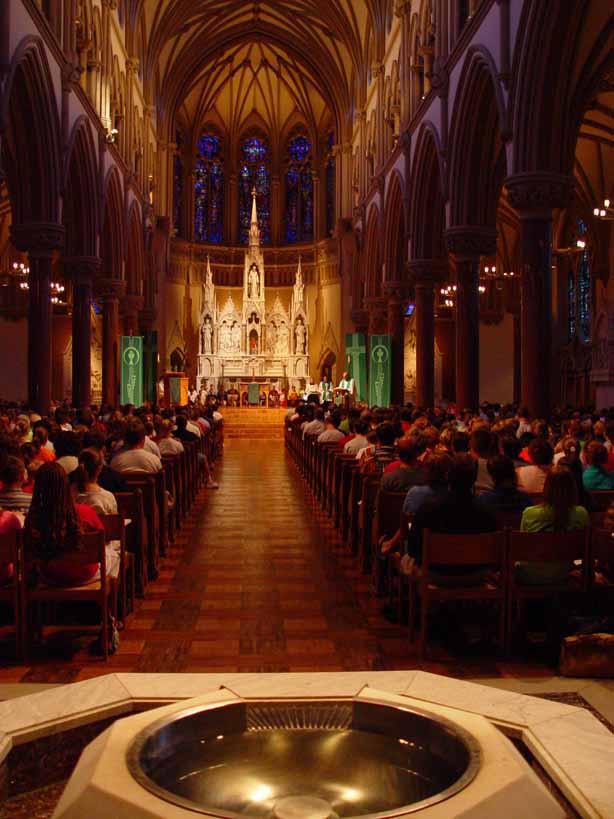
Entering St. Louis Cathedral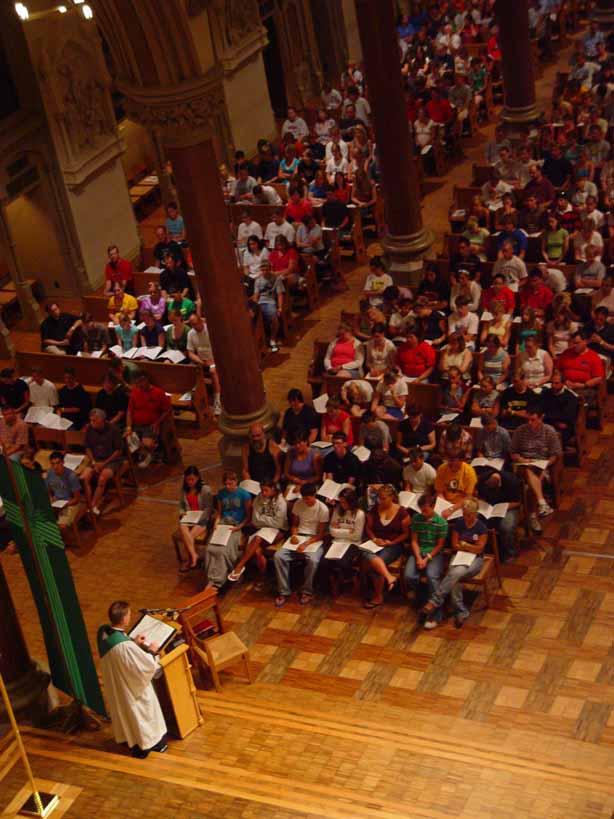

Who is that creepy pastor?!
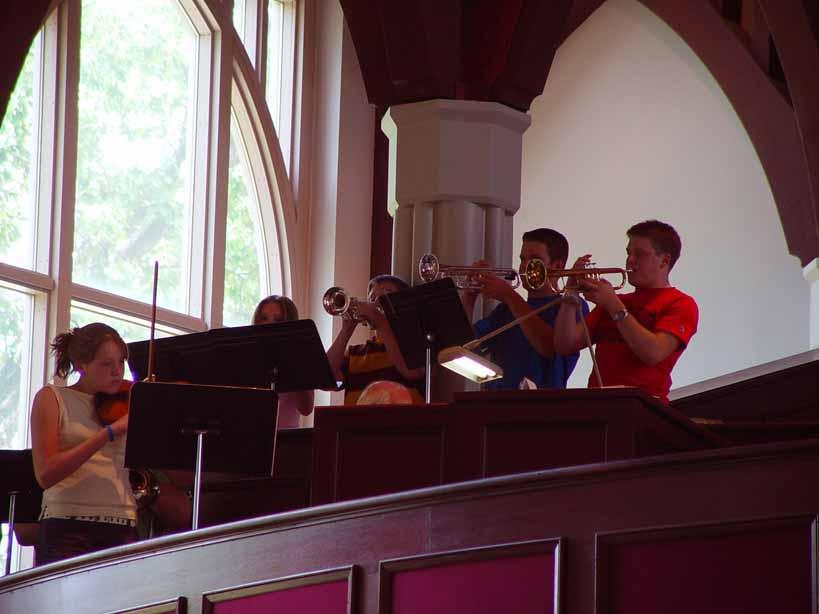
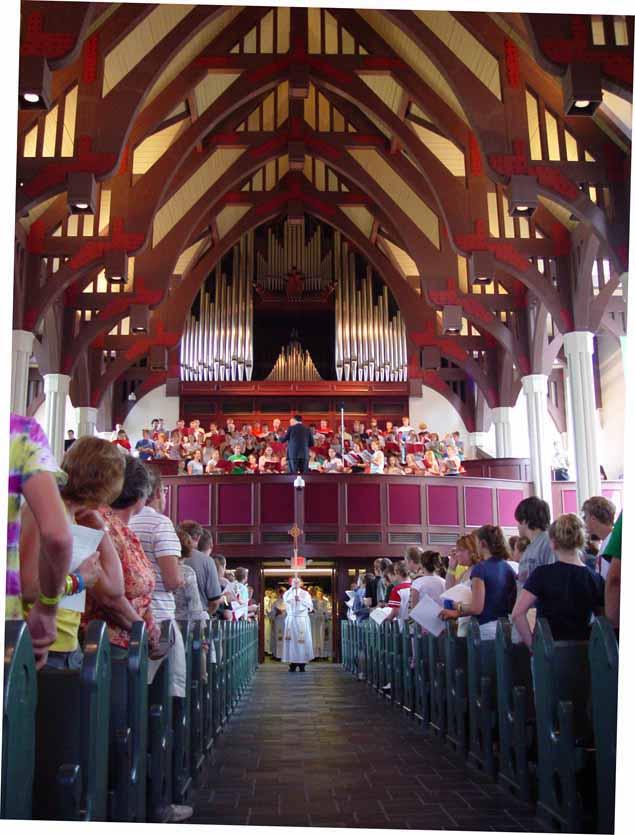
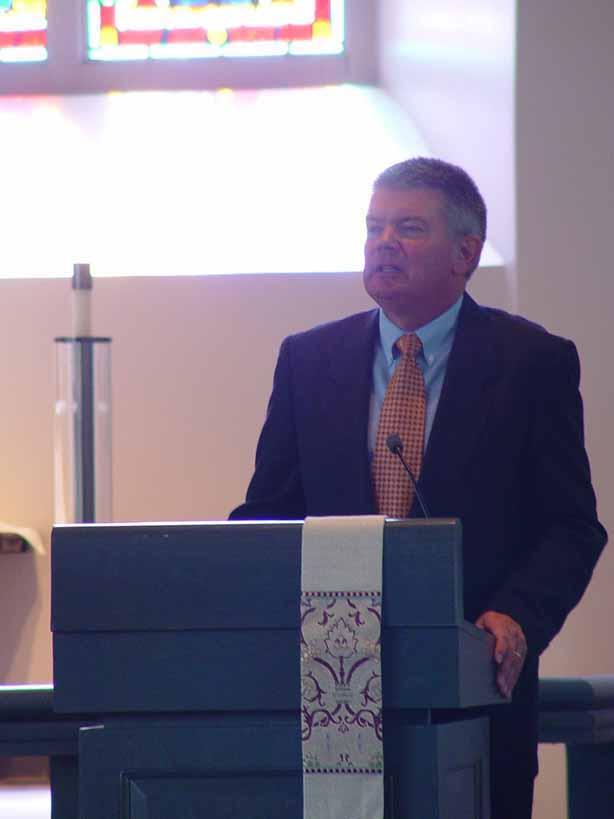
The Holy Eucharist at Concordia Seminary chapel. That's sem president, Dr. Dale Meyer greeting the teens after the benediction.
STUDY



There's that creepy guy again!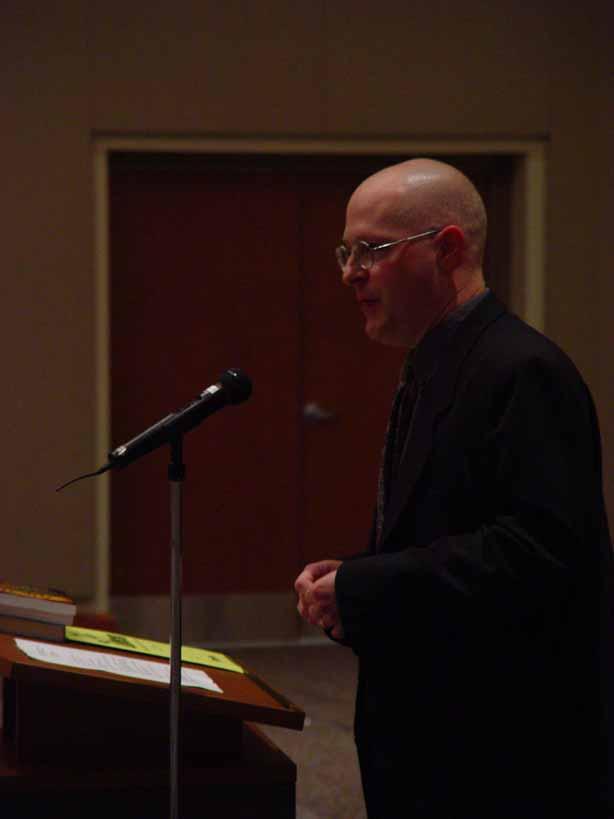
Rev. Todd Wilken the Bald, the radio host of Issues, Etc. gave a talk on UFOs.
FRIENDS



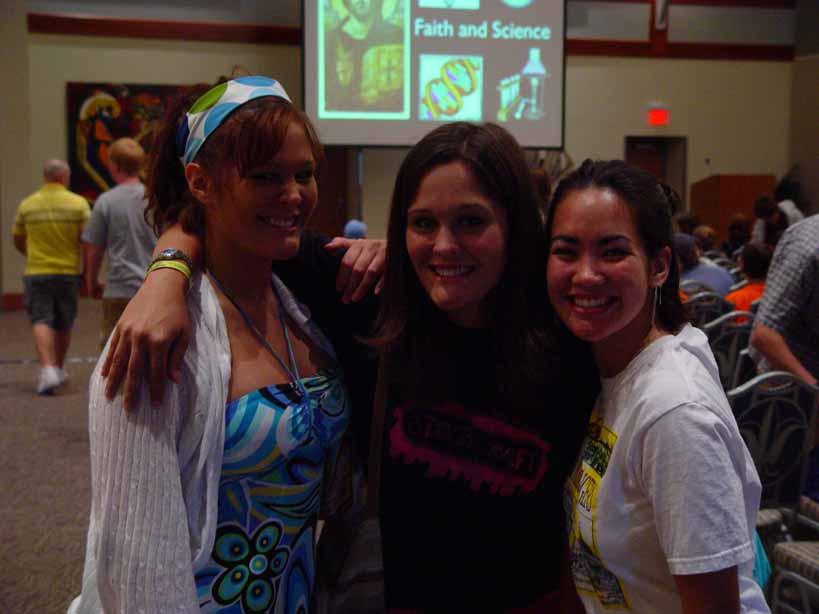

FUN





Indulge Me. Pope Grants Indulgences to Pilgrims
Here is a piece from the Houston Chronicle about Pope Benedict offering indulgences to participants of the World Day of Youth festivities. I think the article does a good job of explaining indulgences in a simple manner.
You are, no doubt, familiar with the 16th century controversy over indulgences that helped to spark the Reformation. Martin Luther nailed his 95 Thesis to the Wittenberg Church door on October 31, 1517 because he wanted to debate the practice of selling indulgences which was taking place in Germany at the time to help raise funds to build St. Peter's basilica in Rome.
The Roman Church teaches that the soul of a Christian must undergo a period of purification after death in order to be made fit to enter heaven. Unbelievers go to hell (assuming people still believe in hell). Believers go to heaven, according to Roman Catholicism, only after a period of purgation. Purgatory is the place or state where a believer's soul is purged of all its impurities.
The idea is that for every sin, there are two kinds of punishment: Temporal and Eternal. Confession and absolution remits the eternal punishments, but penance is required - either in this life or the next - to take care of the temporal punishments. However, the pope believes he can grant indulgences to shorten the span of time a person must spend suffering in purgatory.
At the time of Luther, the Dominican John Teztel (played masterfully by Alfred Molina in the recent film Luther) went about Germany selling indulgences with the slogan, "Whenever a coin in the coffer rings, a soul from purgatory springs." After Luther's complaints, even the Roman officials agreed that Tetzel had gone too far.
But if you thought indulgences were a medieval thing long gone, think again. The current pope is going to offer indulgences to people who participate in certain World Day of Youth events in Germany. But note, only those who are "attentive" will get the boon.
I love my Christian brothers and sisters in the RC church. At times, I feel like I have more in common with some of them than many of the God-lite pastors and practices infecting Lutheranism. However, my understanding of the teachings of Scripture have no room for the idea of purgatory, indulgences or penance. When I grant absolution, it is freely given. I believe that the Gospel itself (the pronouncement of forgiveness on account of Christ's sacrifice) has the power to transform hearts and purify lives. I agree that God uses the sufferings of this life to cleanse, strengthen and discipline His children. But I don't see any clear Scriptural basis for the idea that such suffering and discipline takes place for the Christian after death.
Tuesday, August 23, 2005
The Rise and Fall of the Church
Here is an interesting article from USA Today about the decline of Christianity in Western Europe. It claims that in most of Europe the only major religion that is growing is Islam.
People who know me well, know my interest in the health and growth of churches around the world. And they've heard me comment time and again on the shift that is taking place. The Church began in the Middle East and rapidly spread eastward through Turkey toward India and China. And west and south into Northern and Eastern Africa.
Then Mohammed was born in the sixth century. He and especially his followers spent the next ten centuries wreaking havoc and decimating Christian communities so that now living churches are few and far between in the Middle East and Northern Africa. What had once been a thriving Christian culture has been Islamized, and the people languish in poverty, ignorance and oppression.
Already in the apostolic age, missionaries were going north and west into Europe. As the pagan Celtic and Germanic tribes began to embrace Christianity, what we call the Middle Ages began. And though sometimes mis-characterized as dark ages, the Christian assumptions and worldview created a cultural environment from which have come great universities, astounding works of art, hospitals, literacy, democracy, and the scientific method. Then Europeans emigrated to the New World bringing their Christian faith with them.
The point I am making is that Christianity has seen stages and surges in various places and times. Once North Africa and the Middle East were filled with vibrant Christian communities. These waned and have been nearly extinguished. Then Europe became the heart of Christendom, though it's time has evidently passed. Arguably, the twentieth century was North America's turn. But signs indicate that that is waning as well.
Where is the church strong and growing? To many observers, it appears that the future strength of the church may lie in Africa, South American, possibly Eastern Europe and parts of East Asia.
Monday, August 22, 2005
Evangelical Lutheran Church in America (ELCA) Convention News
The Evangelical Lutheran Church in America (ELCA) is the largest Lutheran body in the United States with something near 5 million members. I am a pastor with the Lutheran Church - Missouri Synod (LCMS) with about 2.5 million.
The ELCA recently concluded their biennial convention at which several controversial resoltuions were under consideration. I'd like to do my best to give a brief summary of two items of interest with some links for further information.
- A New Hymnal. I subscribe to the notion that the manner of one's worship is symbiotically related to the content of one's beliefs. In Latin, Lex Orandi, Lex Credendi. Worship forms matter. The LCMS, at its convention last summer, adopted a new hymnal which will come out in 06. From what I've seen, it has some weaknesses and many strengths.
This summer, the ELCA adopted a new hymnal as well. According to reports, their new worship book contains some very serious theological flaws. The chief concern I have read about is the increasing use of gender neutral language in reference to the Deity. I am understanding of the desire to use gender-sensitive language in many situations and forms of communication. But I think it is intolerable to go out of one's way to neuter God. God has revealed Himself to us as Father, Son and Holy Spirit. And that was not arbitrary or his attempt to be culturally sensitive to patriarchal ancient near easterners. God is Father, Son and Holy Spirit.
Of course, that is not the only manner in which God is named in the Scripture, but it is a highly significant one. The hubris it requires to reject God's name - Father, Son and Holy Spirit - in favor of something that won't offend Gloria Steinem is astonishing.
The formula for performing baptisms given to us by our Lord is "in the name of the Father, the Son and the Holy Spirit." I wonder what this new worship book will do in its baptismal rites. Probably make this traditional name an option, among others.
I will go so far as to say that I would not consider a baptism done with any other formulation for God's name than "Father, Son, Spirit" to be a Christian baptism.
- The second, and more widely publicized, issue has to do with homosexuality. I am not familiar with all of the history of this particular question in the ELCA. And what I have read has been byzantine in its complexity, at least to me.
Basically, there has been a movement to ordain practicing homosexuals and bless homosexual unions. Many in the grassroots, naturally, have not been as supportive of this drive as the members of the various task forces, special committees, etc.
As I understand the matter, this was debated extensively at their convention and the final decisions are seen as something as a compromise. I have read varying interpretations of what was finally passed, so it seems likely that even many of the delegates may be unclear on the remifications of what they've done. It looks to me as if they've created their own version of don't ask / don't tell, giving local ministries and bishops leeway to do what they believe pastorally responsible. If you ask me, this is going to result in further chaos. As it says in Judges, each man does what is right in his own eyes.
Dr. Gene Veith, Culture Editor for World magazine writes this about the inclusive language hymnal.
Rev. Dr. Holger Sonntag is an LCMS pastor who'd formerly attended an ELCA seminary. He has his doctorate in New Testament studies from a German university. He writes this incisive article, posted on Rev. Paul McCain's cyber-brethren blog.
Sphere: Related Content
Sunday, August 21, 2005
On Being Mr. Critical
One reader made a thoughtful comment on one of my previous posts asking me about how I can point my finger at the errorists in other church bodies while my own denomination has plenty of issues as well. His comment was polite, yet challenging. And I thank him for it because I have been thinking about it since then. So I would like to take a moment to get a couple of things off my chest.
- First of all, for the most part, in this blog I post commentary about current events, pop culture, and news from the international church scene. And just as a train wreck will get more coverage than a birth announcement, my commentary probably tends more towards negatives than positives. I don't think I'm a curmudgeon, but if that's how I come across, please grant your indulgence.
- Secondly, I certainly do not believe that my church body (the Lutheran Church - Missouri Synod) is perfect or free of problems. Oh, we have some doozies! Generally, however, I will refrain from directly addressing specific issues in the LCMS on this blog. For various reasons, I do not believe this blog is the best forum for me to air those matters. But don't think this means I avoid taking a stand when necessary. I do and I have and I will. But probably not on a blog. So when I nag or complain or rebuke others, it is not because I believe I am personally sinless or superior or that my own denomination is perfect.
Saturday, August 20, 2005
Guess Which Movie
This website is kind of fun for movie buffs. It's pretty tough, but I did pretty well on the first two rounds. It gives you a couple of obscure shots from a movie and then you have to guess the name of the film.
Sphere: Related ContentFriday, August 19, 2005
African Bishop Calls for the Church of England to be Suspended from Anglicanism
Peter Akinola is the influential Anglican Primate of Nigeria who has been most outspoken against the Episcopal Church - USA for consecrating an openly homosexual bishop. Now he's at it again, persistent fellow. Apparently, the Church of England passed some goofy rule allowing their gay priests to get married as long as they promise not to have gay sex with their partners. Isn't that one of the stupidest things you've ever heard? Just how do they plan to enforce that? What's the point? Because of such craziness, Archbishop Akinola is recommending that the Church of England be suspended from the Anglican Communion. Just you wait. Soon we'll be hearing people calling him divisive. Here's the article.
Sphere: Related ContentThursday, August 18, 2005
Brad Pitt's Anti-Semitic Movie
Well, I don't know that for certain. Let's put it this way, Brad Pitt and Paramount Pictures are set to make a film entitled, The Year of Living Biblically. The stated premise is that the main character determines to follow all the rules of the Old and New Testaments literally (gasp!). I think it's a fair assumption that this is not going to make people like me look good.
Some grouchy unenlightened commentators are saying this is likely to just be another swipe at conservative Christians. Maybe. But if I were an Orthodox Jew, like say, Sen. Joseph Lieberman, I'd definitely be paying attention.
I took the Jewish angle because it is considered suave and fashionable to mock conservative Christians. Jews get slightly more respect nowadays. Of course, if you really want to be the darling of Hollywood, go Buddhist or better yet, adopt the religion of Sheila-ism. You remember that woman named Sheila who made up a new religion entirely based around herself. That's what most of us reeeeaaalllyy are anyway, no matter where we sit on Sunday morning (or Saturday or whatever).
It's a free country. Let them make whatever movie they please. But when a film intentionally mocks a major world religion (mine or yours), I would expect outcry. Didn't Voltair once say, "I may not agree with what you say. . . and if I don't you can expect me bust your chops"? I may not have that quote exactly right.
Hey, I'm no stick in the mud. I can appreciate a certain level of irreverent humor. But making fun of God's Word is dangerous.
I read one report that suggested a movie called something like The Year of Living Koran-ly. Like that would ever happen. But it does. Everytime you see one of those blow-em-up action flicks where the bad guys are Islamic terrorists, you are watching a movie about people who try to live according to the Koran literally. Read it, if you don't believe me.
Wednesday, August 17, 2005
"Da Vinci Crock," I Mean "Code"
I was so delighted when I heard a while back that the Anglican officials refused to give permission for Ron Howard to make his newest movie in Westminster Abbey. The Da Vinci Code movie, based on the Dan Brown book of the same name will star Tom Hanks and seems to be nearing completion. Then I read this bit from Mere Comments by James Kushiner.
Apparently, not all Anglicans are willing to turn revisionistic, historically illiterate hacks away from using their church properties to slander Jesus. At least not when 100,000 British pounds come into the picture. Yes, a Rev. Alec Knight has allowed the filmmakers to use Lincoln Cathedral. And, of course, the church will be rewarded handsomely.
Sadly, the modern Church of England - as a whole - is not particularly known for its concern for getting the Jesus stuff right, but I was encouraged by a rare bit of backbone shown by the caretakers of Westminster Abbey. [There's the old joke: Why does the bishop lay his hands on the head of the new ordinand? It's easier to remove his spine.] Then I read about this Lincoln Cathedral business. After all, what's integrity when you've got to pay the gas bills each month?
I have read The Da Vinci Code. I have also read other books by Dan Brown. Assuming Ron Howard's film follows the book at all, it will be a horrible movie. It makes me sad, frankly. The people the Church is called to minister to, and the world in which this takes place, is increasingly ignorant of Biblical content. 'Tis a fact. And we're even less well-informed, I think, about the history of Western Civilization. I have spoken to far too many people whose primary (or secondary) source of religious information is T.V. and film. People figure, why do I need to go to Bible study or get my kids involved in church? We go on X-mas and Easter, sorta.
It's one thing to write a novel. It's quite another to write a novel about actual historical subjects without evidence of genuine research and filled with errors any 9th grader a hundred years ago would've been able to spot and then publicly claim to be writing true stuff. Someone said, "a little knowledge is a dangerous thing." Dan Brown is the poster boy for that slogan. He takes a bit of fact and goes bonkers with it. Gee, buy an encyclopedia already.
Y'know those people who watch Battlestar Gallactica on television and soak in its underlying mythology of how ancient space aliens populated the earth and built the pyramids - - and believe it's true? That's what The Da Vinci Code is doing for many people concerning the historical person of Jesus Christ.
Tuesday, August 16, 2005
Tom Cruise on Psychiatry
This evening, as I was re-reading the post I put up yesterday, it occured to me that one of my comments (at least) was not as clear as it should have been and could be misleading. I wrote:
Or how about when Tom Cruise (whom I believe to be a terrific actor)
lectured America - in a profoundly inarticulate verbal belch - on the validity
of psychiatric medicine?
That was one sentence in a post about celebrities who spout off on subjects they are poorly informed about. But it dawned on me, as I re-read my words, that my statement could be understood to say that Tom Cruise believes in the validity of psychiatric medicine and I think he's an ignoramus for it. The fact is, I intended to convey the opposite.
Tom Cruise, as a devoted Scientologist, thinks that all psychiatric medicine is quakery. As you may know, he got into quite a ridiculous showdown with Matt Lauer on the Today show over the matter. Go here to read the transcript of that broadcast.
You see, I believe that psychiatry - and the use of antidepressant drugs, in particular - have genuine merit. And I criticize Cruise, and all of his Scientology weirdo friends, for trashing it all entirely. That's a dangerous religion, people.
Some will point to the checkered history of psychiatry. Sure, there are plenty of horror tales and examples of cruelty in psychiatry. But the practice of medicine is an art as much as a science. Name one single field of medicine that doesn't have a freaked out past. I'm sure that in a hundred years - when medical knowledge and technology will contain wonders we can't even dream about now - our great-grandchildren will consider us barbarians for allowing surgeons to actually cut on us with knives. Ooooooh!
The brain is an organ of the body. And like all the other organs, it can malfunction, get sick and respond to treatment. It does get a bit tricky, I realize, because we have to deal with the mind/brain connection. Healing of the mind and healing of the brain go hand in hand, but they are not identical. Clearly, I am of the opinion that the Holy Spirit, the sacraments, and trust in the promises of God's Word bring peace and comfort and aid to the troubled mind.
But I am also quite convinced that maladies such as Schizophrenia, Obsessive Compulsive Disorder, Depression, and others can and do respond to medical treatment, including drugs. I thank God for the ongoing developments in treating mental illnesses just as much as I thank him for the x-ray and the polio vaccine.
I'm not saying a person shouldn't exercise caution before undergoing psychiatric treatment. An individual should read and study up on any medication before they take it, psychiatric or otherwise.
But instead of blasting people for taking such meds, as Cruise did, we - especially we in the church - should show compassion toward the sick and those afflicted with mental illness and support them with our love, prayers and actions.
If you, or someone in your family, is mentally ill (or you suspect may be), let me tell you about an excellent organization whose work I highly champion. It's called the National Alliance for the Mentally Ill. They are a wonderful source of information, direction and support, not just for those with mental illness, but for their family and friends as well.
Sphere: Related ContentMonday, August 15, 2005
Bono, Celebrities, and Stuff of Substance
[Warning: Glaring generalization ahead] Most of the time, when I hear celebrities commenting on religion or ethics, I know I'm going to need to crack open another bottle of Pepcid AC. Even if I kinda like the person, I frequently wince on account of their breathtaking ignorance of the subjects they choose to comment on. I know this will be a splash of cold water for some, but having your face on GQ or Seventeen doesn't make one an authority on the crisis in the Sudan, epidemiology, or bio-ethics. I'm no expert on most of that stuff either, but I hope I generally know when to plug the hole in my face. One gets the impression that most celebrity Mensa candidates wouldn't know an ebola virus if it challenged them to an arm wrestle. Take for instance, the lovely and talented young actress, Scarlet Johansonn who recently opined that fetal stem cell research is necessary so that we can find cures for such scourges against humanity as polio, etc. Huh? Polio is under control, my dear, and no one had to carve up fetuses to do it. (On that, check out the recent research from Pittsburgh's Children's Hospital which shows that adult, or post-natal, stem cells are as useful for medical research as fetal stem cells.)
Or how about when Tom Cruise (whom I believe to be a terrific actor) lectured America - in a profoundly inarticulate verbal belch - on the validity of psychiatric medicine? This is the guy who believes that the source of all our problems is that we're all infected with spiritual cooties from ancient space aliens. He's not in the best position to call anyone a quack.
Everyone has a right to his or her opinions and I am an ardent believer in freedom of speech. But that is not to excuse pomposity, an inflated sense of self-importance or grinding stubborn ignorance.
My dad used to tell me that it is better to keep your mouth closed and be thought an idiot than to open it and remove all doubt. I've said and done enough stupid things myself to see his point.
[Alert: Refreshing exception ahead] While bags and bags of Hollywood celebrity types are too pampered and self-indulgent to form a meaningful sentence on their own, there are refreshiing exceptions. Readers of this blog have seen my relatively high regard for Bono, the lead singer of perhaps the most famous rock band in action today, U2. Now there is a man who has held AIDS babies and slept beneath mosquito netting.
Christianity Today has given us these excerpts of an interview he did some time ago. You must go here too, while you're at it. And though I don't agree with everything he says, I am pleased to know that at least one hugely influential celebrity is more than chrome-plated faddish activism. His positions on religion and human care go beyond deciding which color of ribbon to wear on his Armani tuxedo to the Wolfgang Puck after-party.
I believe Bono has some truly lucid insights on the person of Jesus Christ and His work as Savior. He seems to have a very accurate and personal understanding of the atonement and his thoughts on Karma vs. Grace sound a lot like, in my vocabulary, Law and Gospel. In fact, some of his comments in this interview are 10 times better than the flacid drivel most American preachers drool out every Lord's day. Take two and half minutes and read it. He even does a bit of C.S. Lewis.
Now I'm not recommending we give the man a blue-ribbon for Lutheran orthodoxy in every point, but I'm certain there has never been a more serious thinking or theologically articulate rock star in the "history of the whole world" (as Bunnie Diehl likes to say). Now that is a celebrity that I'd love to have a beer or three with sometime . . . oh, and Mel too.
Wednesday, August 10, 2005
Is the Nation Really in Favor of Abortion?
Friend and fellow Lutheran blogger, Bunnie Diehl, has made an excellent point here. She cites an article by Matt Kaufman at Boundless magazine. Basically, the point is that if the country is so clearly pro-abortion, as the prophets of death proclaim, then why are they so worried that Roe v. Wade will be overturned? As Kaufman explains it, a reversal of Roe v. Wade would only re-grant the individual states the right to enact their own abortion laws. So what does NARAL have to worry about? If their analysis of the population's views is correct, then reversing Roe v. Wade should have little or no effect on the actual availability of abortion. Unless, of course, the constantly touted statistics about how much Americans love abortion are skewed and misleading. I propose that underneath their bluster, the death merchants realize that the American people would prefer there to be much greater restictions on abortion rights . . . if actually given a say in the matter.
Sphere: Related ContentFriday, August 05, 2005
"Til Death Do Us Part" or Whatever
An article at FoxNews.com addresses a disturbing trend in wedding vows. It appears that instead of the traditional 'Til death do us part," some couples today are opting for these much less permanent-sounding alternatives:
- "For as long as we continue to love each other."
- "For as long as our time shall last."
- "For as long as we are together."
If you want to go that route, why prettify the language? Why not just say what you really mean? "Until I get sick of you," or "Until someone better comes along," or "As long as I'm not bored, inconvenienced, or unhappy."
Marriage is a life-long union of one man and one woman. Divorce happens and I understand that. That is evidence of the brokenness of creation. All of us children of Adam are sinful and do sinful things. In some circumstances, divorce may actually be the lesser of two evils. It can be very complicated. Divorce, when it happens in the church, should be addressed with loving application of Law and Gospel (Call to repentance and Absolution). Compassion must be shown to those whose hearts, lives and homes are broken. But to begin your life together publicly acknowledging that "hey, we're gonna give it a shot, but this gig may not work out y'know," is insane. What kind of commitment is that?
Human marriage is an image of the relationship between Christ and His Bride, the Holy Church. If I look in a carnival mirror, my face may be all elongated and distorted in funny ways. But thankfully, that's not how I really am. Honest. Human marriage, after being expelled from Eden, is sadly often a warped reflection of the beautiful thing it is meant to display.
What would our Lord's wedding vows sound like? "I will love you with an everlasting love," or "I'll stick this out until someone with shaplier legs saunters by?"
Sphere: Related Content


